

Solar expert Yasser Siddiqi explains why rising bills and grid failures are pushing Pakistani families toward full energy independence
Key Takeaways:
- Net billing did not kill solar demand — it redirected it toward self-consumption and battery storage.
- Off-grid solar has shifted from a financial choice to a resilience and security decision for Pakistani families.
- Poor battery settings and undersized systems, not bad equipment, cause most solar failures in Pakistan.
Karachi, Pakistan — Engineer Yasser Siddiqi has spent years doing something most energy consultants do not: answering ordinary Pakistanis’ questions about solar power through Facebook, free of charge. What began as guidance on cutting electricity bills has evolved into a broader mission. In an exclusive interview with Money Matters Pakistan, he argues that Pakistan is not merely witnessing a solar trend, it is in the early stages of an irreversible energy transformation, one being driven not by government planning but by household necessity.
From Saving Money to Taking Control
Yasir Siddiqui traces his interest in off-grid solar to a pattern he kept encountering. “People didn’t just have high bills, they had no control over their electricity,” he said. “Energy is not just a utility — it’s a form of sovereignty.” That realization shifted his focus from helping families trim costs to helping them escape dependence on an unreliable national grid altogether.
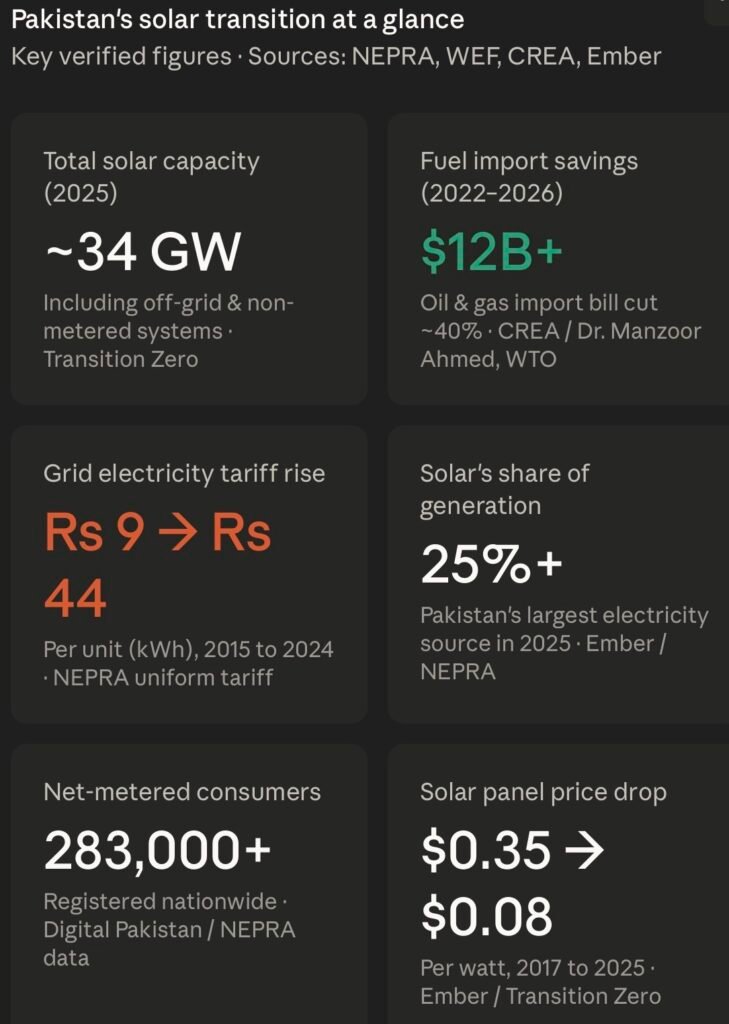
The timing of that shift matters. Pakistan’s electricity tariffs have more than doubled since 2021, according to data tracked by the National Electric Power Regulatory Authority (NEPRA), while load-shedding has remained a persistent feature of daily life across the country. Those conditions, Yasir says, have changed the very question families ask when evaluating solar. “Earlier, solar was evaluated on payback period. Now, it’s being valued for reliability, control, and peace of mind.”
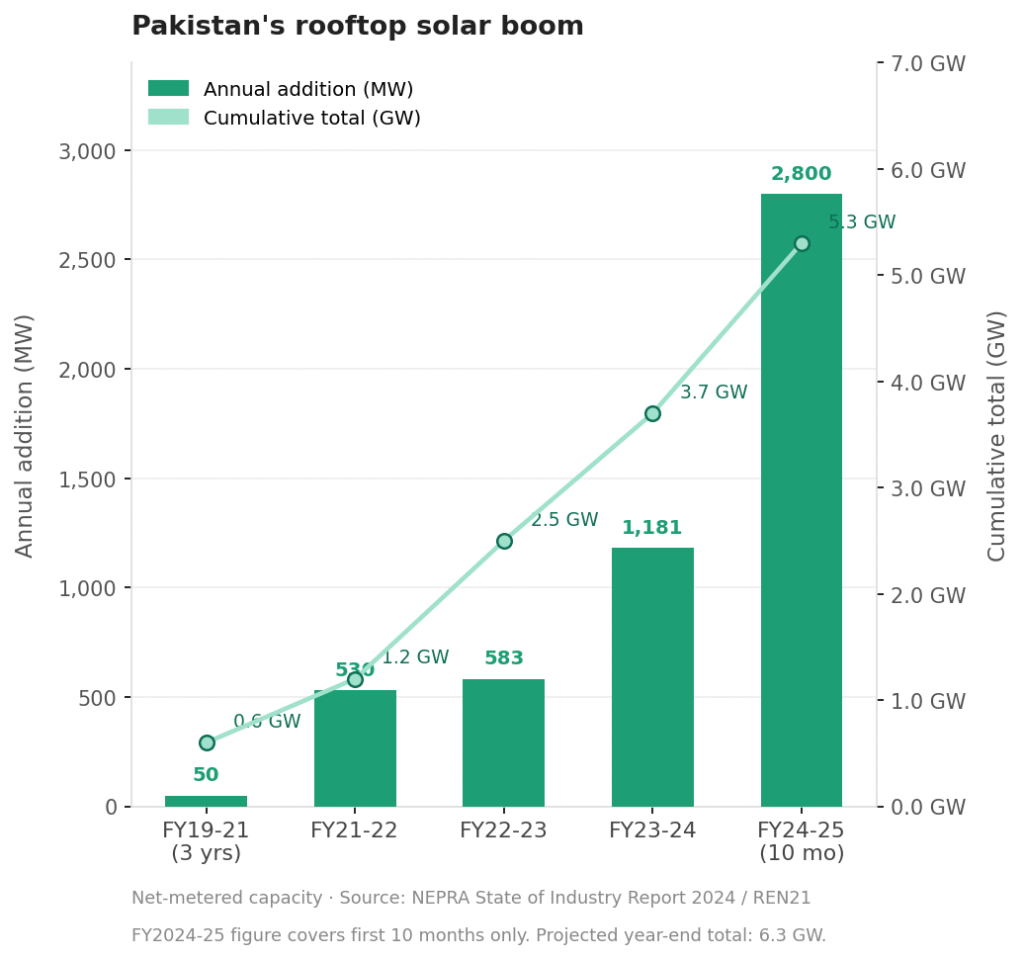
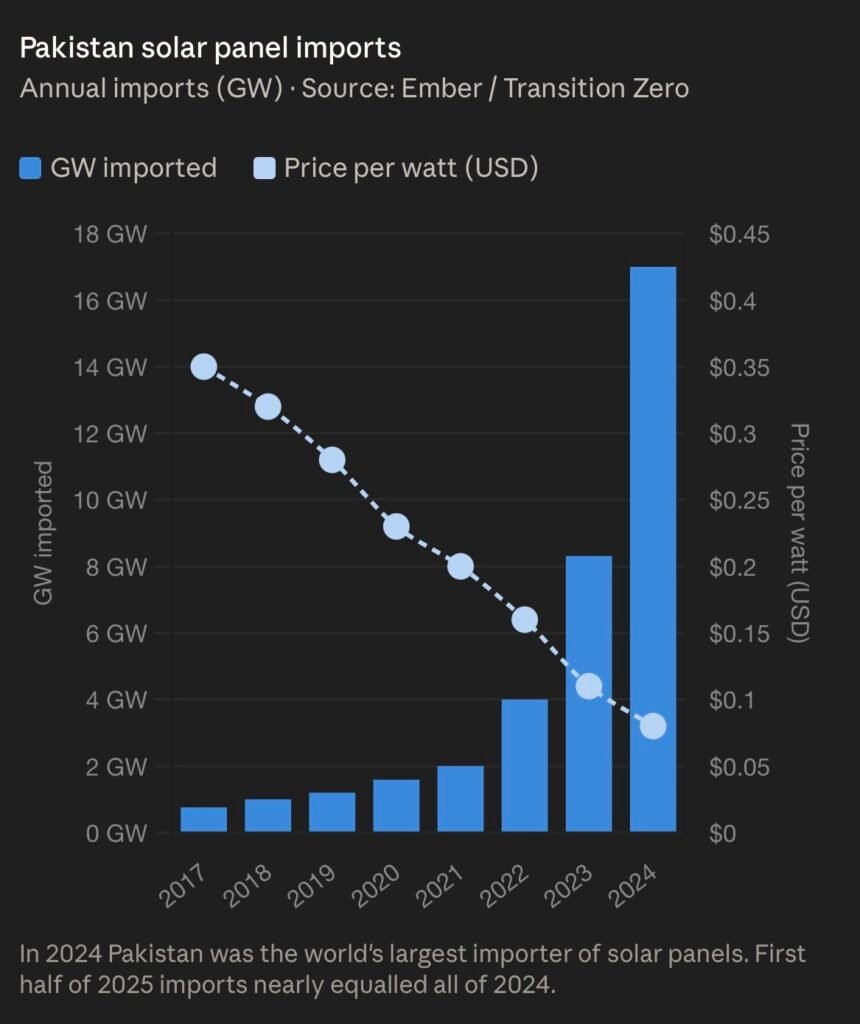
The scale of Pakistan’s solar shift is backed by hard numbers. According to NEPRA’s State of Industry Report 2024, Pakistan added 583 MW of net-metered rooftop solar capacity in 2022-23, a figure that more than doubled to 1,181 MW in 2023-24. By April 2025, rooftop installations had surged to 2.8 GW in just the first ten months of fiscal year 2024-25, bringing the cumulative national total to 5.3 GW, a nearly tenfold increase in just two years. In 2024 alone, Pakistan imported 17 GW of solar panels, more than any other country in the world that year, as electricity prices doubled between 2021 and 2024. Beyond net-metered systems, the picture is even larger. A study by research group Transition Zero estimates Pakistan’s total installed solar capacity, including off-grid and non-net-metered systems, at approximately 34 GW, with off-grid systems alone accounting for an estimated 8.31 GW, exceeding the country’s peak grid electricity demand in the last fiscal year.
Net Billing Changed the Shape of Solar, Not the Direction
A common narrative holds that the government’s recent shift from net metering to net billing, under which surplus electricity is purchased from consumers at rates far below what they pay to buy it back, dealt a blow to solar adoption. Yasser Siddiqi pushes back on that reading.
“The shift to net billing was not the main reason people moved toward off-grid systems — it simply accelerated a trend that was already underway,” he said. The original solar boom, in his view, was driven by rising tariffs, unreliable supply, and falling panel prices. Net metering made the economics attractive, but net billing has changed the strategic logic rather than the outcome. Consumers are now focused on using as much of their own solar power as possible rather than exporting it, which is pushing battery adoption upward and producing better-designed, more efficient systems.
Similarly, notices from distribution companies and threats of meter replacement, which have alarmed some solar users, are, in Yasser Siddiqi’s assessment, pushing people toward smarter decisions rather than away from solar entirely. “Design your system around self-consumption first, and treat the grid as a backup — not the foundation,” is his advice for anyone considering a new installation today.
Policy Is the Bottleneck, Not Consumer Appetite
On government policy, Yasser Siddiqi is direct. Taxes on solar panels, inverters, and batteries raise upfront costs and slow adoption. Sudden regulatory shifts create the kind of uncertainty that discourages long-term investment. And the fixation on buying back electricity at low rates distracts from what should be the real policy goal: reducing the burden on a grid that Pakistan can no longer afford to keep expanding through imported fuel.
“The government needs to treat solar not as a revenue source, but as infrastructure relief,” he said. “Every unit generated privately is a unit the grid doesn’t have to produce or subsidize.”
He outlines three changes that would make a genuine difference: removing or reducing taxes on essential solar components for residential users, committing to policy stability so that rules do not change overnight and redirecting incentives toward self-consumption and battery storage rather than grid exports.
A Security Question, Not Just a Financial One
Regional instability and volatile global fuel markets have added a new dimension to the solar calculation. Pakistan’s power sector depends heavily on imported fuel and price shocks abroad translate directly into higher electricity costs at home. For families already dealing with that pressure, Yasir Siddiqui says the decision to go solar has stopped being purely about finances.
“For many households today, off-grid solar is shifting from a financial decision to a resilience decision,” he said. The ability to run cooling, water supply, lighting, and other essentials without exposure to outages or fuel-driven price spikes now carries a value that goes beyond any payback calculation.
By April 2025, rooftop installations had surged to 2.8 GW in just the first ten months of fiscal year 2024-25, bringing the cumulative national total to 5.3 GW, a nearly tenfold increase in just two years.
At the national level, he argues the response has not kept pace with the urgency. Consumer-level adoption is moving quickly, driven by individual necessity. But government policy and grid-level planning remain inconsistent. “This shift should have been treated as urgent infrastructure transformation — something to be accelerated over a few years, not stretched over decades.”
The macroeconomic payoff of this consumer-led transition is now becoming visible at a national scale. A joint analysis by the Centre for Research on Energy and Clean Air (CREA) and Renewables First found that Pakistan’s grassroots solar surge drove a 40 percent drop in oil and gas imports between 2022 and 2024, delivering what years of state energy policy had failed to achieve: falling fuel import dependence and stronger energy security. According to analysis cited by Dr. Manzoor Ahmed, a trade arbitrator at the WTO in Geneva, solar adoption generated savings exceeding $12 billion by early 2026, a significant figure for a country chronically constrained by foreign exchange shortages. The timing is particularly consequential. Pakistan imports a large share of both LNG and oil through the Strait of Hormuz, and in 2024 still ranked third globally in LNG dependence on Hormuz-transiting cargoes.
Iranian forces declared the Strait of Hormuz closed on March 2, 2026, following US-Israeli military operations against Iran, carrying out confirmed attacks on ships attempting to transit the waterway. According to ship-tracking data from Kpler, traffic through the strait dropped to a fraction of its pre-war level of around 100 vessels per day, cutting global oil and gas supply by roughly 20 percent in what analysts have described as the largest fuel supply disruption on record. Pakistan, which sourced almost all of its 2025 LNG supply from Qatar, is among the most acutely exposed countries in South Asia, with limited storage and procurement flexibility leaving it vulnerable to rapid power-sector demand destruction. Pakistan’s solar boom has not eliminated that exposure, but has meaningfully cushioned it. The country had already cancelled 35 LNG cargo deliveries for 2026, before the crisis began as solar-driven displacement reduced import demand, and is now deploying a combination of demand curtailment, fuel switching, and renewable generation expansion to manage the supply gap.
The Hybrid vs. Off-Grid Decision
For a middle-class family weighing its options, Yasser Siddiqi offers a clear framework: “Hybrid saves money, off-grid gives control.” A hybrid system reduces bills significantly, costs less upfront, and delivers a faster return on investment — but it leaves the household exposed to future tariff increases and policy changes. A fully off-grid setup requires higher upfront spending, mostly due to battery costs, but locks in energy costs and eliminates grid dependence.
“Today, more people are leaning toward off-grid not because it’s cheaper upfront, but because uncertainty in the system has become more expensive than the extra investment,” he said.
For a family with Rs. 1.5 million to invest, his priority order is clear: put the bulk into a properly sized solar array first, choose a quality inverter that can handle peak loads and future expansion, and add battery storage only to the level genuinely needed. “Most people do the opposite — they overspend on batteries and undersize their solar, which kills returns.”
EVs, Second-Life Batteries, and What to Watch
With electric vehicles beginning to appear in Pakistani cities, Yasser urges buyers to plan for EV charging from the start rather than treating it as an afterthought. An EV can add eight to fifteen units of consumption per day, often making it the single largest load in the home, and the solar array, inverter capacity, and usage timing all need to be sized accordingly. Daytime charging is strongly preferable since it avoids the need for a much larger and expensive battery bank.
On the growing interest in repurposing old EV batteries for home storage, he is cautious. The technology is viable in controlled, well-engineered deployments, but he warns that Pakistan’s summer heat accelerates degradation in batteries that are already partially worn and typically lack the thermal management systems they had when installed in vehicles. For the average household, new lithium batteries remain the safer and more predictable choice.
Buying Right in a Market Full of Fakes
The solar equipment market in Pakistan carries significant risks for ordinary buyers. Yasser Siddiqi identifies misrepresentation, used or downgraded products sold as new, as the central problem. His warning signs include pricing that seems too low to be genuine, sellers who cannot provide datasheets or serial numbers, vague or shifting answers about what cells are inside a battery, warranties that promise only repair rather than replacement, and visible signs of wear on equipment presented as new.
“Energy is not just a utility — it’s a form of sovereignty.”
~ Engineer Yasir Siddiqui
On battery technology, he makes a strong case for Lithium Iron Phosphate over lead-acid options. LFP batteries handle deeper discharge, higher temperatures, and significantly more charge cycles. Lead-acid may appear cheaper upfront but degrades quickly in Pakistan’s heat and ends up costing more over time. Most early LFP failures, he adds, are not the result of faulty batteries but of incorrect charging settings, insufficient low-voltage cutoffs, oversized loads on undersized batteries, poor ventilation, and weak battery management systems.
Looking Three to Five Years Ahead
Pakistan’s recently reported lithium deposits in Balochistan and Khyber Pakhtunkhwa have generated considerable attention. Yasir Siddiqui tempers the optimism. Extracting lithium is only the first step; turning it into competitive batteries requires refining infrastructure, cell manufacturing capacity, skilled workers, and sustained policy support. None of which currently exist at scale in Pakistan. The most realistic near-term pathway, he says, is local assembly of battery packs using imported cells, which could reduce costs and build domestic expertise. Full cell manufacturing is realistically a decade or more away. Without strategic action, Pakistan risks becoming a raw material exporter that still imports finished batteries.
On next-generation panel technology, he is equally measured. Higher-efficiency panels will begin reaching Pakistan within one to two years and become more common over three to five years as prices settle. But improvements will be incremental rather than disruptive, and the more important constraints for most users are system design and storage, not panel efficiency. “Waiting for better panels is usually the wrong decision. You’ll save far more by installing today and avoiding high electricity costs than by waiting a few years for marginal gains,” he said.
The concept of shared neighborhood solar systems — a common microgrid serving several homes on the same street — is technically sound, he acknowledges, but faces serious practical obstacles in urban Pakistan. Disputes over ownership, usage and maintenance responsibility, combined with a regulatory framework built entirely around individual meters, make it unworkable for most residential settings today. Apartment buildings and gated communities with clear management structures are more promising candidates.
Pakistan had already cancelled 35 LNG cargo deliveries for 2026, before the crisis began as solar-driven displacement reduced import demand, and is now deploying a combination of demand curtailment, fuel switching, and renewable generation expansion to manage the supply gap.
His overall assessment of where Pakistan stands is measured but firm. “The revolution is happening with or without policy — but with the right policies, it could be faster, cleaner, and far more beneficial for the country.”
For families standing at the beginning of this decision, his starting advice is simple: “Start with your consumption, define your goal, and build step by step. You don’t need to understand everything — you just need to make the right first decision.”