


Proposed amendments to introduce facial recognition via NADRA and restrict transactions to verified bank accounts or e-wallets
Key Takeaways:
- SECP proposes IBAN verification via RAAST and NADRA-aligned facial recognition for digital investor onboarding.
- Investors must use verified bank accounts or e-wallets only, improving transaction traceability.
- Regulated Persons remain fully responsible for KYC and AML compliance; public feedback open for 14 days.
ISLAMABAD – The Securities and Exchange Commission of Pakistan (SECP) on Thursday proposed sweeping amendments to the country’s anti-money laundering framework, making IBAN verification and multi-biometric authentication mandatory for fully digital onboarding of investors.
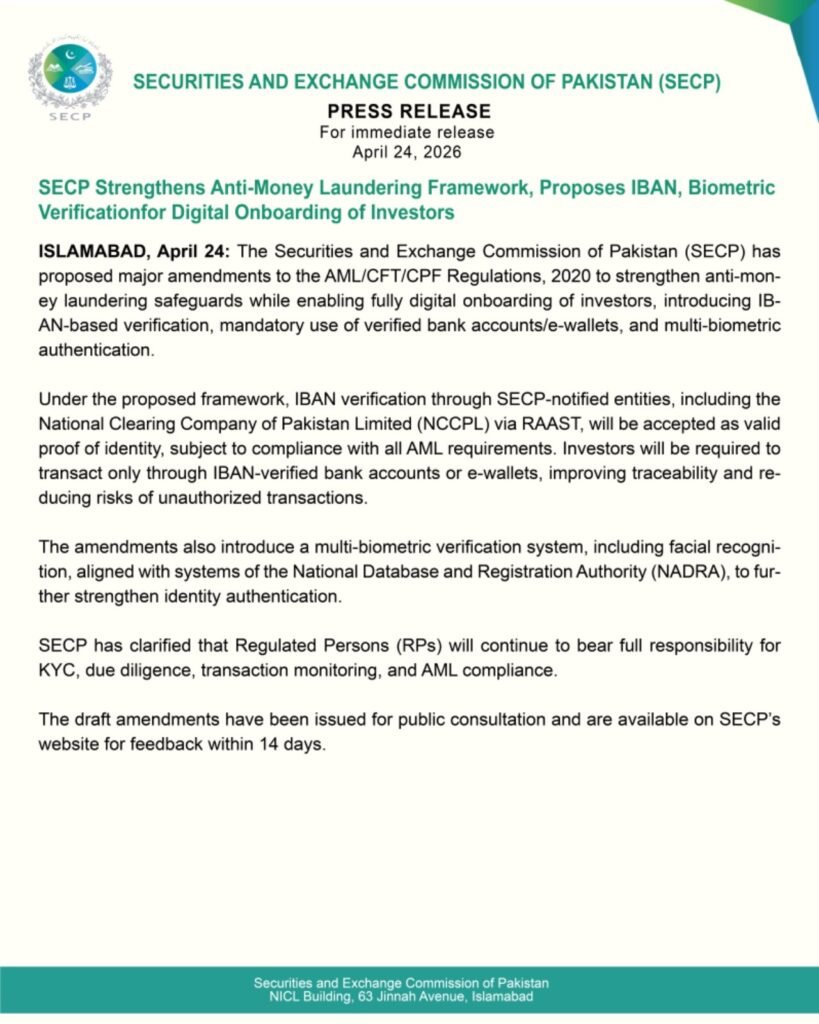
Under the draft amendments to the AML/CFT/CPF Regulations, 2020, issued for public consultation, SECP has mandated that investors shall transact only through IBAN-verified bank accounts or e-wallets, a move aimed at improving transaction traceability and reducing risks of unauthorised financial activities.
“IBAN verification through SECP-notified entities, including the National Clearing Company of Pakistan Limited (NCCPL) via RAAST, will be accepted as valid proof of identity,” the press release said, adding that such verification must comply with all AML requirements.
In a significant step to strengthen identity authentication, the regulator has also proposed a multi-biometric verification system that includes facial recognition, aligned with the systems of the National Database and Registration Authority (NADRA). Officials say this will make it considerably harder for fake or stolen identities to be used in financial markets.
However, SECP has made it clear that Regulated Persons (RPs)—including brokerage houses, asset management companies, and other financial intermediaries—will continue to bear full responsibility for Know Your Customer (KYC), due diligence, transaction monitoring, and overall AML compliance.
The draft amendments have been placed on SECP’s official website for public feedback, with a deadline of 14 days from April 24, 2026. Market participants expect the new rules to be finalised shortly thereafter.
Analysts view the move as a balancing act: enabling seamless digital onboarding while plugging loopholes that could be exploited for money laundering or terrorist financing.