
Arif Habib data shows exports rebounded 14% year-on-year in April 2026 but were swamped by a 17% surge in imports
Key Takeaways:
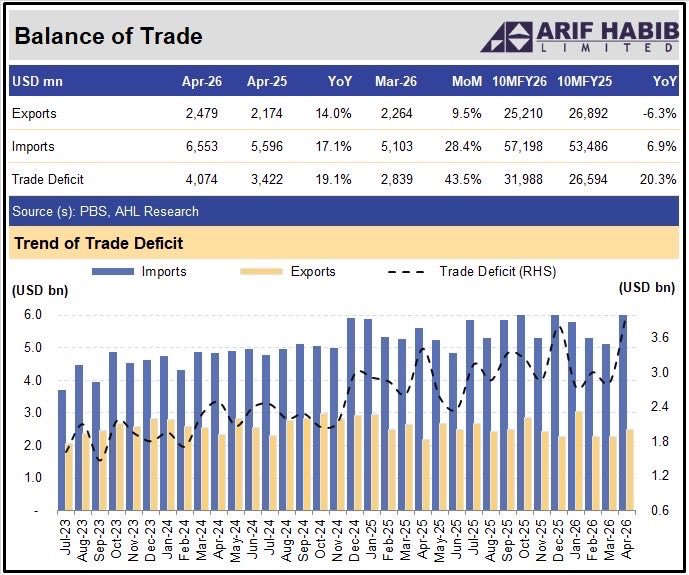
- Pakistan’s trade deficit widened 19.1% year-on-year to $4.07 billion in April 2026, driven by a sharp 28.4% month-on-month surge in imports to $6.55 billion — the highest single-month import bill in years.
- Exports rose a healthy 14% year-on-year to $2.48 billion in April, but fell well short of compensating for surging import volumes linked to oil prices, LNG procurement and rising food import costs.
- The cumulative 10-month trade deficit for FY26 now stands at $31.99 billion — already 20.3% wider than the same period last year, with two months of the fiscal year still remaining.
Karachi, Pakistan – Pakistan’s monthly trade deficit ballooned to $4.07 billion in April 2026, according to data compiled by Arif Habib Limited (AHL) based on Pakistan Bureau of Statistics (PBS) figures — marking a 19.1% year-on-year deterioration and a sharp 43.5% jump from the $2.84 billion deficit recorded in March.
The April reading represents one of the worst single-month trade deficits in Pakistan’s recent history, driven almost entirely by a dramatic surge in imports rather than a collapse in exports.
Imports Spike to $6.55 Billion
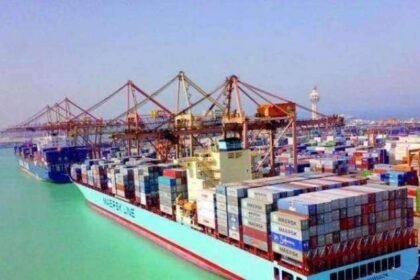
The import bill for April 2026 came in at $6.55 billion — up 17.1% compared to $5.60 billion in April 2025, and a striking 28.4% higher than the $5.10 billion recorded just one month earlier in March. The sharp monthly jump reflects the cascading impact of elevated global oil prices triggered by the US-Iran conflict, accelerated LNG procurement as Pakistan scrambles to restore gas supply to power plants, and a structurally rising food import bill. As Business Recorder reported, imports rose 6.64% to $50.54 billion in the first nine months of FY26, up from $47.39 billion a year earlier — and April’s $6.55 billion reading suggests that momentum has intensified sharply in the final quarter of the fiscal year.
Exports Recover but Cannot Keep Pace
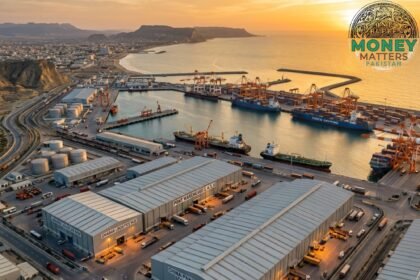
On the export side, April offered a modicum of relief. Exports rose 14% year-on-year to $2.48 billion, up from $2.17 billion in April 2025, and 9.5% higher than the $2.26 billion recorded in March. However, as AHL’s data makes clear, this recovery is dwarfed by the scale of import growth. On a cumulative 10-month basis, exports for FY26 stand at $25.21 billion — down 6.3% from $26.89 billion in the same period of FY25 — while imports have risen 6.9% to $57.20 billion from $53.49 billion a year earlier.
A $6.55 billion import bill in a single month is not just a trade statistic. It is a flashing warning light on Pakistan’s external account dashboard — and it is getting brighter.
The Widening Full-Year Picture
The cumulative 10-month trade deficit for FY26 now stands at $31.99 billion — a 20.3% increase over the $26.59 billion recorded in the same period of the previous fiscal year. This trajectory puts Pakistan on course for a full-year trade deficit that could comfortably exceed $35 billion, well above what policymakers had anticipated at the start of the fiscal year.
The widening gap adds fresh pressure to Pakistan’s external account at a moment when the country is already managing a fragile balance of payments position, a recent 100 basis point rate hike, and ongoing dependence on bilateral and multilateral financing to sustain foreign exchange reserves.