
CIPS crosses 1.22 trillion yuan in a single day as geopolitical tensions accelerate the renminbi’s rise globally and reopen questions for Pakistan’s trade future with Beijing.
Key Takeaways:
- China’s cross-border payment system CIPS hit an all-time high of 1.22 trillion yuan processed in a single day, with nearly 42,000 transactions, signalling a dramatic acceleration in yuan-based global trade.
- With CIPS now connected to over 5,000 financial institutions across 190 countries, the yuan’s role as a settlement currency is increasingly rivalling dollar-based infrastructure amid growing geopolitical tensions.
- For Pakistan, which has formally agreed to use CIPS for CPEC-related transactions and has allowed yuan use in bilateral trade, this milestone creates both an opportunity and an urgency to deepen financial integration with China.
Money Matters Monitoring — China’s cross-border payment infrastructure is writing new history. The Cross-border Interbank Payment System (CIPS) recently recorded a single-day transaction value of 1.22 trillion yuan, equivalent to approximately $178.5 billion, with nearly 42,000 transactions processed in a single session, according to the state-owned Shanghai Securities News. Both figures represent all-time highs for the system.
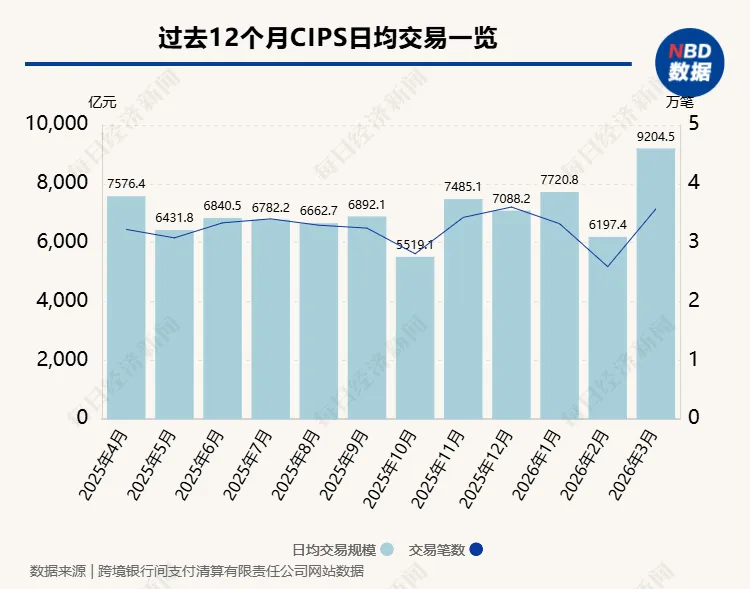
The record-breaking day was not an isolated event. In March, CIPS averaged 920.45 billion yuan in daily transaction value, the highest monthly average in a year and a nearly 50 percent rise from February’s 619.74 billion yuan. Average daily transaction volume in March also climbed to 35,740, sharply up from 25,930 in February.
When the renminbi stays stable while other currencies falter, it does not just attract trade, it attracts the entire global payments architecture.
The expansion of the network itself tells an equally striking story. By the end of 2025, CIPS had 193 direct and 1,573 indirect participants spanning 124 countries and regions, providing cross-border services to over 5,000 banking institutions across 190 countries and regions, according to China Daily.
For context, the SWIFT messaging network still connects over 11,500 institutions across more than 235 countries and territories, meaning CIPS remains a smaller but fast-growing alternative, as analysed by FXC Intelligence.
Analysts point to the geopolitical environment as a key driver behind CIPS momentum. Ming Ming, chief economist at CITIC Securities, has noted that with rising geopolitical risks, the renminbi has maintained relative stability, making it an increasingly attractive currency for settlements, which in turn generates greater demand for CIPS transactions. Analysts further noted that the yuan’s relative stability, China’s investment in cross-border payment infrastructure, and the growing number of CIPS participants have all reinforced this upward trend, as reported by the South China Morning Post.
Pakistan already has the legal framework in place to trade in yuan through CIPS. The question is whether Islamabad has the financial ambition to fully use it.
The momentum reflects a broader strategic shift. Since Russia’s removal from the SWIFT network in 2022, countries across Asia, the Middle East, Africa, and the BRICS bloc have increasingly explored yuan-based settlement as an alternative to dollar-dominated infrastructure. Beijing recently undertook the first major update to the business rules governing CIPS in eight years, effective February 2026, expanding its mandate beyond yuan transactions to include offshore yuan and other business approved by the People’s Bank of China, as reported by the South China Morning Post.
For Pakistan, this global shift carries direct relevance. The official Long Term Plan for CPEC explicitly endorses CIPS as the preferred clearing and settlement mechanism for Pakistan-China transactions. The two countries have agreed to encourage clearing and settlement of financial institutions through CIPS and to promote the use of domestic currencies, including the renminbi and the rupee, to reduce dependence on third-party currencies for bilateral trade and investment, as documented on the CPEC Secretariat’s official website.
In 2025, CIPS handled payment transactions worth 180.2 trillion yuan, up from 175 trillion yuan in 2024, with direct participants for the first time including foreign-invested institutions in Africa, the Middle East, Central Asia, and the Singapore offshore yuan center. In 2026, CIPS transactions are expected to expand further, with business types potentially extending from traditional trade settlement to financial market settlement, liquidity management, and integrated cash management.
For Pakistan the rise of CIPS is not merely a distant financial story. It is an opening. Whether Islamabad chooses to deepen its use of CIPS infrastructure beyond formal agreements and into actual transactional volume could prove consequential for how Pakistan manages its bilateral financial relationship with its largest economic partner in the years ahead.