
Beijing’s May export ban on a foundational industrial chemical, triggered by the Iran war and Hormuz blockade, threatens fertilizers, metals, batteries, and food prices worldwide.
Key Takeaways:
- China will stop exporting sulfuric acid from May 2026, removing the world’s single largest supplier of the chemical from global markets at a time of already acute supply stress.
- The ban is a direct consequence of the Iran war: the closure of the Strait of Hormuz has cut off sulfur shipments from the Middle East, which China depends on for over half its sulfur raw material needs.
- The ripple effects will hit phosphate fertilizer prices, copper mining, battery manufacturing, and semiconductor production globally, with food-importing nations facing the sharpest downstream pain.
Money Matters Monitoring – In a move that could reshape global supply chains across agriculture, mining, and technology, China has announced it will halt exports of sulfuric acid starting in May 2026. The decision, driven by acute domestic shortages stemming from the Iran war and the blockade of the Strait of Hormuz, threatens to send prices soaring across industries that touch nearly every aspect of modern life.
China has indicated it will halt exports of sulfuric acid from May, hitting metals and fertilizer industries already strained by raw material bottlenecks resulting from the Iran war. Some sulfuric acid producers in the country recently received notifications about the change, and one large buyer has been told about it by their Chinese supplier. The ban will cover sulfuric acid that is a by-product of copper and zinc smelting in China. Bloomberg
The development was first reported by Bloomberg, whose full report can be read at bloomberg.com. Industry publication Acuity first flagged the Chinese ban on April 9, reporting that the restriction could last throughout 2026.
Why Sulfuric Acid Matters
To understand the weight of this decision, one must understand what sulfuric acid actually does. It is the world’s most produced industrial chemical by volume, and its applications span from the most basic to the most advanced corners of the global economy. Roughly 60 to 70 percent of global sulfuric acid output goes into producing phosphoric acid, which is then used to manufacture phosphate-based fertilizers such as DAP (diammonium phosphate) and MAP (monoammonium phosphate), the fertilizers that underpin crop yields for billions of people. Beyond agriculture, the chemical is essential in copper and lithium mining, oil refining, lead-acid car batteries, semiconductor manufacturing, dyes, detergents, and metal processing.
Put simply, sulfuric acid is a building block of industrial civilization. When its supply tightens, the consequences cascade.
The Hormuz Connection
The root of China’s problem lies in the Persian Gulf. China sources more than 50 percent of its sulfur requirements from the Middle East, where sulfur is a natural by-product of oil and gas refining. Sulfuric acid prices have been rising since the start of the Iran conflict, as the effective closure of the Strait of Hormuz blocks sulfur shipments from the Middle East. The region produces one third of the world’s sulfur, a raw material used to make sulfuric acid that is essential for some copper extraction and phosphate fertilizers. SupplyChainBrain
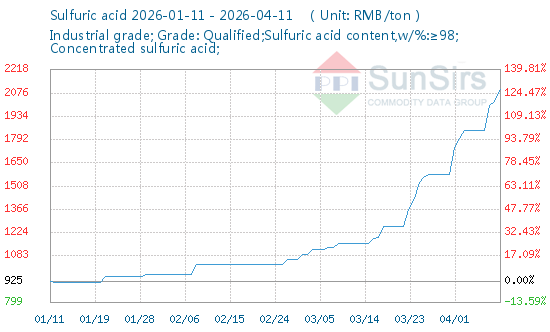
The supply squeeze has already pushed Chinese domestic sulfur prices sharply higher. Chinese domestic sulfur prices have been increasing steadily over the course of the war to date, reaching record highs of 4,815 to 4,820 yuan per tonne, equating to a rise of more than 20 percent in just over two weeks. Argus Media
With its own raw material supply under pressure, Beijing has moved to conserve what it has. China is cutting off its exports of sulfuric acid to conserve its domestic resources heading into planting season. About 45 percent of sulfur exports pass through the Strait of Hormuz, and China is one of the world’s largest exporters of sulfuric acid. China exported around 349 million dollars worth of sulfuric acid in 2024, over 100 million dollars more than any other country. Washington Examiner
Sulfuric acid is not just a chemical. It is the invisible thread running through fertilizers, copper, batteries, and chips. Snap that thread, and entire industries unravel.
Who Gets Hit Hardest
The squeeze will hit the copper-mining industries in key producers such as Chile, the Democratic Republic of Congo, and Zambia. Prices have already surged in Chile, which buys over one million tonnes of Chinese sulfuric acid every year. Around a fifth of the copper output in Chile, the world’s number one producer, involves a type of processing that depends on sulfuric acid. SupplyChainBrain
According to acid analyst Sarah Marlow of Argus, as reported by SupplyChainBrain: “If the suspension is enforced for the full year, the Chileans will be faced with even higher prices than we are seeing today.” The full SupplyChainBrain report can be read at supplychainbrain.com.
Beyond Chile, Indonesia, Thailand, Malaysia, India, and Brazil also face significant exposure through their mining and fertilizer industries. The ban on Chinese sulfuric acid exports will simultaneously hit electric vehicle production, chip manufacturing, and food output, a rare convergence of industrial pain points landing at the same time.
Food Prices on the Line
The agricultural dimension of this ban is where ordinary people around the world will feel the pinch most directly. Phosphate fertilizers are what allow farmers to grow the corn and soy that feed livestock, which in turn produce meat, eggs, and dairy for billions of consumers. Sulfuric acid comes primarily from oil refining, meaning that nearly 50 percent of global sulfur flows pass through the Strait of Hormuz, along with around 18 percent of the global trade in MAP and DAP, two leading phosphate fertilizers. Expana
The combination of volatility around the Strait of Hormuz and China’s export halt does not bode well for fertilizer prices nor for the world’s biggest sulfuric acid importers. All eight major fertilizers have seen a price increase over the past month, including slight increases in the two major phosphate fertilizers, diammonium phosphate and monoammonium phosphate. Washington Examiner
For countries already struggling with food inflation, higher fertilizer input costs arriving at the start of planting season represent a particularly dangerous combination. Pakistan, which produces only about 0.7 million tonnes of DAP annually while total annual requirements exceed 2 million tonnes, leaving the vast majority of supply dependent on imports, PCMA sits among the nations most exposed to this disruption.
Beijing is not just conserving a chemical. It is mapping the chokepoints of the global economy, one export ban at a time.
Can Anyone Fill the Gap?
The honest answer, according to analysts, is not quickly. The loss of Chinese volumes will be difficult to offset, given the parallel shortage of sulfur feedstocks. SupplyChainBrain Alternative producers in Europe, Peru, South Korea, and the United States can ramp up output over time, but cannot bridge a shortfall of over one million tonnes in the near term. Higher freight costs and logistics constraints add further friction to any rerouting of supply.
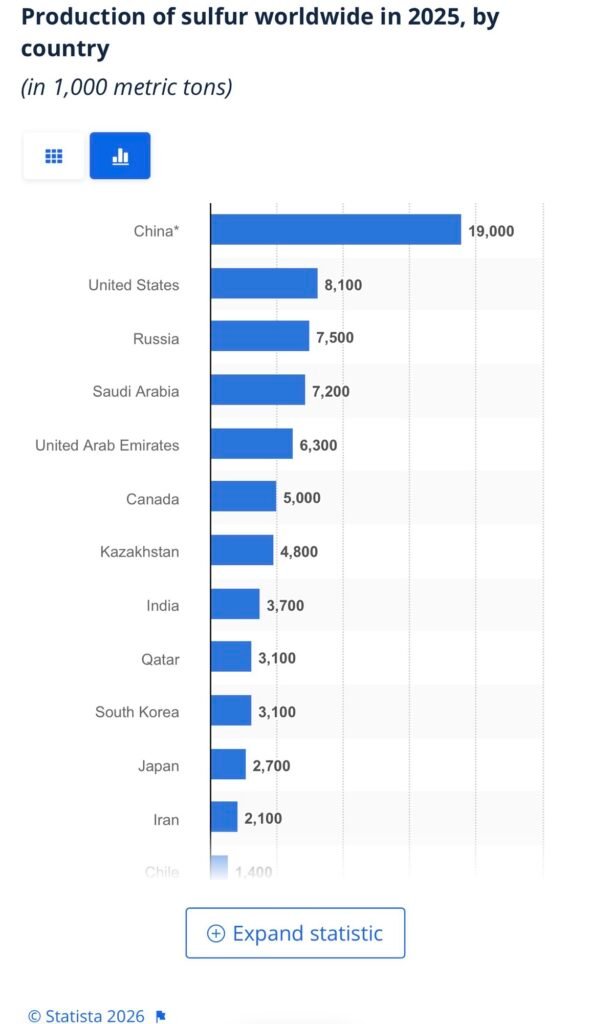
Global sulfuric acid production currently stands at roughly 250 to 300 million metric tonnes annually, with China accounting for approximately 88 to 95 million metric tonnes of that total, or nearly a third of world output. For detailed global sulfur production statistics by country, the Statista data page can be accessed at statista.com.
A Strategic Signal
What makes this moment significant beyond the immediate supply disruption is what it reveals about China’s broader strategic calculus. While much of the world’s attention has been fixed on tariff percentages and trade war headlines, Beijing has been methodically identifying and acting on real-world chokepoints in industrial supply chains. A single export ban on one chemical touches electric vehicles, semiconductors, food production, and metals processing simultaneously. That is not a coincidence. That is leverage.