
Islamabad’s last-minute diplomacy may have saved the world economy from a catastrophic meltdown: Atif Mian
Key Takeaways:
- Pakistan’s diplomatic intervention had a measurable global economic impact: The ceasefire brokered with Pakistan’s involvement triggered a 2.9% jump in the S&P 500, translating into an estimated $3.6 trillion gain across global markets.
- Pakistan created value worth ten times its own GDP for the world: With global markets valued at approximately $125 trillion, even a modest market recovery driven by the ceasefire dwarfs Pakistan’s entire economic output.
- A new identity beckons: Princeton economist Atif Mian argues the real opportunity for Pakistan lies not just in the financial numbers, but in cementing its role as a credible, peace-promoting nation.
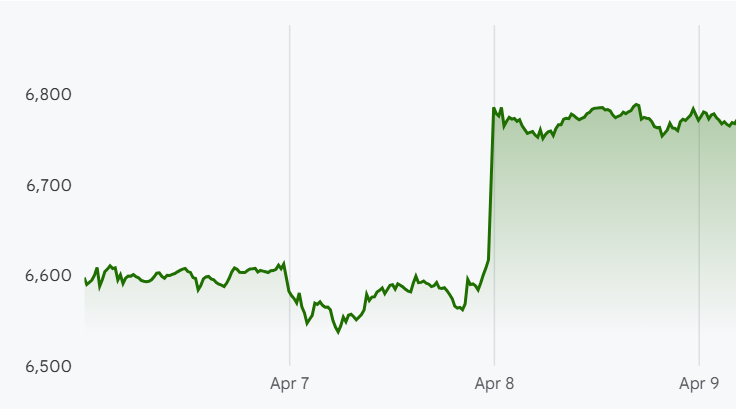
Money Matters Monitoring – On the evening of April 7, the world was holding its breath. A Trump ultimatum set for 8pm had markets in freefall and prediction platforms giving less than a 5% probability of a ceasefire between the United States and Iran. What followed in the next few hours would not only pull the world back from the brink of a catastrophic conflict, it would also produce one of the most remarkable economic turnarounds in recent memory, with Pakistan playing a starring role.
With global markets representing roughly $125 trillion in value, a 2.9% gain across the board translates into a wealth creation of $3.6 trillion in a single day.
In a recent post on 𝕏, Princeton University economist and one of the world’s leading macroeconomic thinkers, Professor Atif Mian, has put a striking dollar figure on what Pakistan’s diplomatic intervention that evening was worth to the global economy.
According to Professor Mian, it was a “flurry of last-minute diplomacy led by Pakistan’s PM Shehbaz Sharif” that flipped ceasefire odds from “near-impossibility to 100%,” with both American and Iranian leadership publicly acknowledging Pakistan’s pivotal contribution. The market reaction was immediate and dramatic. As Professor Mian notes, “there was a sharp jump of 2.9% in S&P500 around the ceasefire announcement,” and the reaction, he adds, “was similar the world over.”
Putting a Price on Peace
The math that follows is staggering. With global markets representing roughly $125 trillion in value, a 2.9% gain across the board translates into a wealth creation of $3.6 trillion in a single day. To put that in perspective, Pakistan’s own GDP stands at approximately $350 billion. As Professor Mian puts it plainly, “Pakistan helped create TEN times its own GDP for the world.”
The analysis is significant not merely as an exercise in numbers, but because it offers a rare, clean methodology for valuing diplomatic outcomes. The sharp and near-instantaneous shift in ceasefire probability, from near-zero to certainty, allowed markets to price in the change in real time, making it possible to isolate and measure the economic impact of Pakistan’s role with unusual precision.
The market reaction was immediate and dramatic. As Professor Mian notes, “there was a sharp jump of 2.9% in S&P500 around the ceasefire announcement,” and the reaction, he adds, “was similar the world over.”
Beyond the Trillions
Yet for Professor Mian himself, the financial calculation is almost secondary. “For me, the best part is not the trillions of dollars,” he writes, “but seeing Pakistan on the world stage as a peace maker.” It is a sentiment that resonates deeply given how rarely Pakistan has been cast in that light in recent decades, more often making international headlines for economic distress, political instability, or security concerns.
Professor Mian sees the ceasefire moment as the opening of a door, one that Pakistan should walk through deliberately. “I hope Pakistan runs with this new identity by promoting peace not only abroad, but also at home,” he states, adding that this means “moving away from politics of division and exclusion, and treating every citizen as its own.”
A Moment Pakistan Cannot Afford to Waste
For a country that has spent the better part of the last two years negotiating IMF bailouts, managing currency pressures, and battling political polarisation, the events of April 7 offer something rare and valuable: a moment of unambiguous national achievement on the world stage.