
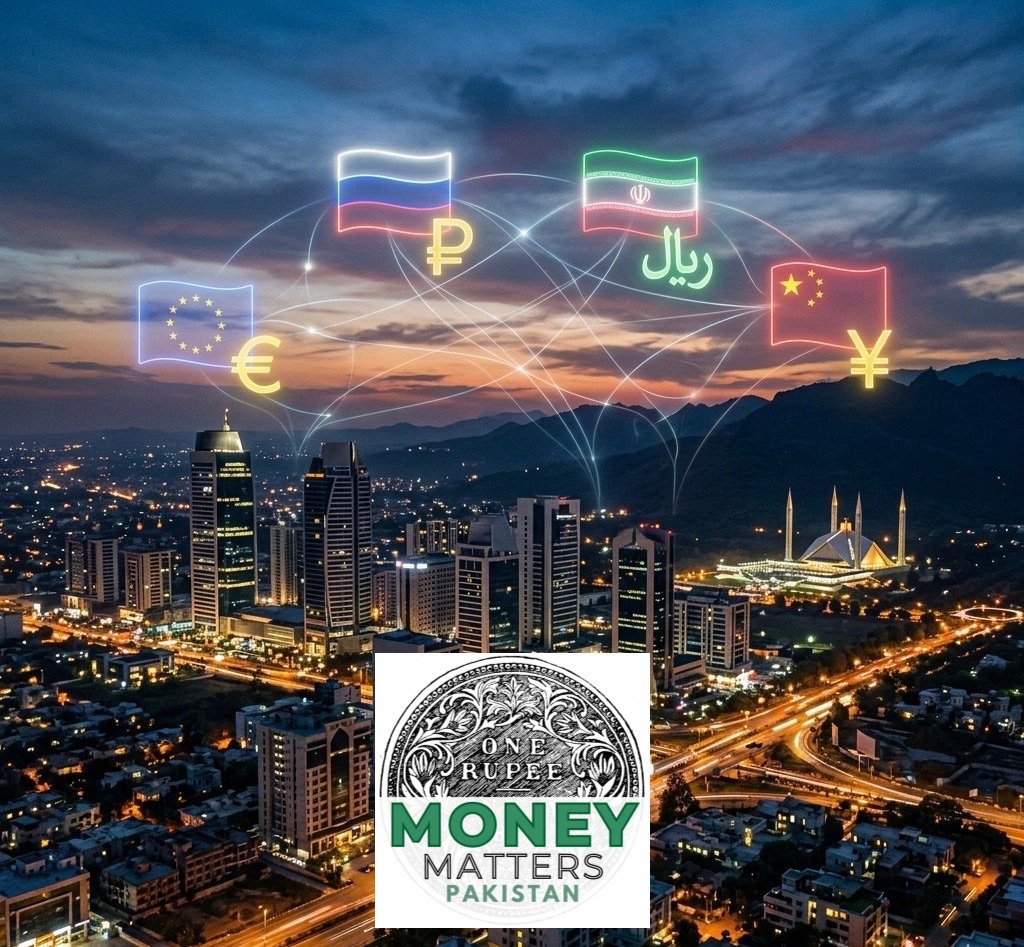
PM’s Office pushes regional currency swaps and deeper trade integration as Pakistan tackles dollar‑driven debt and IMF compliance
Key Takeaways
– Pakistan is fast‑tracking currency swap agreements with the EU, Russia, Iran and ASEAN‑member countries to reduce dollar dependence and link trade more closely to regional currencies.
– The government is repaying $4.8 billion in external debt this month while simultaneously pledging with the IMF to ease currency controls and allow the rupee to stabilise and gradually appreciate.
– Ambitious medium‑term targets include cutting the debt‑to‑GDP ratio, lowering external debt and interest‑payment burdens, and lifting GDP growth to 6–8 percent by 2029, but these goals appear difficult without sustained structural reforms and external support.
Money Matters Monitoring – The Prime Minister’s Office has directed the Ministry of Finance to finalise currency swap agreements with the European Union (EU), Russia and Iran, in what officials say is a strategic bid to reduce Pakistan’s dependence on the US dollar and ease pressure on foreign‑exchange reserves.
Currency swaps on fast track
According to The Express Tribune, which reported that the Prime Minister’s Office has issued fresh instructions on the matter, the agenda of currency swap agreements has been folded into the finance ministry’s strategic reforms framework and is now being tracked by the PM’s Delivery Unit. Government sources cited in the report say Pakistan aims to sign pacts with Iran, Russia, the EU and ASEAN‑member countries along the lines of the long‑standing Pakistan‑China currency swap arrangement.
Under the existing Pak‑China swap, Islamabad has drawn around $4.5 billion in trade‑related liquidity, although much of it has been used to service debt rather than directly boosting trade. The deals with Russia and Iran are seen as especially important for opening new trade corridors and cutting costs linked to dollar‑denominated oil and energy imports.
Debt stress and IMF conditions
The push for swaps comes as Pakistan repays $1.3 billion in Eurobond debt, the first major instalment under roughly $4.8 billion in external obligations due this month. Finance Minister Muhammad Aurangzeb told the media that the country remains “committed to honouring its external obligations in a timely manner,” underscoring an effort to preserve its credibility with international lenders even as reserves remain tight.
At the same time, the IMF has asked Pakistan to unwind currency‑control measures, including directives for banks to surrender foreign exchange to the central bank and restrictions on outbound remittances, provided reserves are adequate. The government is also being pressed to stabilise the monetary market in a way that allows the rupee room to appreciate gradually against major currencies.
Policy rate, debt targets and growth goals
The PM’s Office has also asked the finance ministry, in coordination with the State Bank of Pakistan, to design a roadmap to bring the policy rate below 10 percent, even as Pakistan recently pledged to raise interest rates under the current IMF programme to tame inflation. This dual‑track approach—tightening initially while later promising easing—reflects the difficulty of balancing growth, debt servicing and external‑sector stability.
Authorities are also tightening rules to curb manipulation of the exchange rate, hoarding and illegal smuggling of foreign currency, especially against the backdrop of market expectations that the $4.8 billion debt wave could force devaluation. Pakistan is further exploring the use of the Asian Clearing Union mechanism for trade‑settlements and plans an awareness campaign to nudge importers, exporters and investors towards using such alternative channels, including trade with China in RMB.
Ambitious debt and growth targets
The PM’s Office has tasked the finance ministry with bringing down the country’s high debt burden, even though the recently launched Medium Term Debt Management Strategy 2026–28 contains goals that independent analysts view as overly optimistic. The plan aims to reduce the debt‑to‑GDP ratio to 61.5 percent by 2028, cut external debt to 17.9 percent of GDP and bring interest payments down to 4.9 percent of GDP by the same year—levels that would be hard to achieve without sustained strong growth and concessional financing.
The roadmap also calls for keeping the current‑account deficit below 3 billion dollars and gradually turning it into a surplus, while pushing GDP growth from 4–5 percent in the next two years to 6–8 percent by 2029, and lifting the size of the economy to $500 billion. For Pakistan’s fragile balance‑of‑payments position, success will depend not only on swaps and cheaper credit lines but also on structural reforms that can sharply boost exports and FDI.