

Diesel, tomatoes, and LPG lead price surge as SPI data reveals deepening cost-of-living pressure across income groups
Key Takeaways
- Sharpest weekly SPI rise in two years: Pakistan’s Sensitive Price Indicator jumped 1.93% week-on-week for the period ending April 9, 2026, with fuel prices, particularly diesel at 54.71%, acting as the primary driver.
- Year-on-year inflation at 12.15%: On an annual basis, fuel and food prices have surged dramatically, with diesel more than doubling and staples like onions, wheat flour, and tomatoes recording double-digit gains.
- All income groups affected: From the lowest to the highest consumption quintile, every segment recorded a price increase, underscoring that the inflationary wave is broad-based and not limited to premium goods.
Islamabad, Pakistan – Pakistan’s Sensitive Price Indicator (SPI) rose by 1.93% for the week ended April 9, 2026, marking the sharpest weekly increase in two years, according to data released by the Pakistan Bureau of Statistics (PBS). The jump signals renewed inflationary pressure on everyday households, particularly those in lower income brackets.
The SPI, which tracks price movements of 51 essential commodities across 50 markets in 17 cities, recorded week-on-week gains across all five consumption quintiles. The highest-income group (Q5) saw a 2.50% rise, while even the lowest quintile (Q1) recorded a 0.75% increase, confirming that inflation is cutting across all segments of society.
Diesel prices alone surged 54.71% in a single week, a shock that will ripple through transport, agriculture, and supply chains nationwide.
Fuel prices drove much of the weekly surge. Diesel prices shot up by 54.71% and petrol by 17.86%, delivering a direct blow to transportation, logistics, and agricultural costs. LPG, widely used for cooking in urban and peri-urban households, rose 8.61%, adding further strain to kitchen budgets already stretched thin.
On the food front, tomatoes climbed 9.35%, potatoes 4.13%, and onions 3.84%, three staples that anchor daily meals for millions of Pakistani families. Eggs rose 3.77%, mutton 1.05%, cooked daal 0.88%, and bread 0.47%, leaving few affordable options untouched.
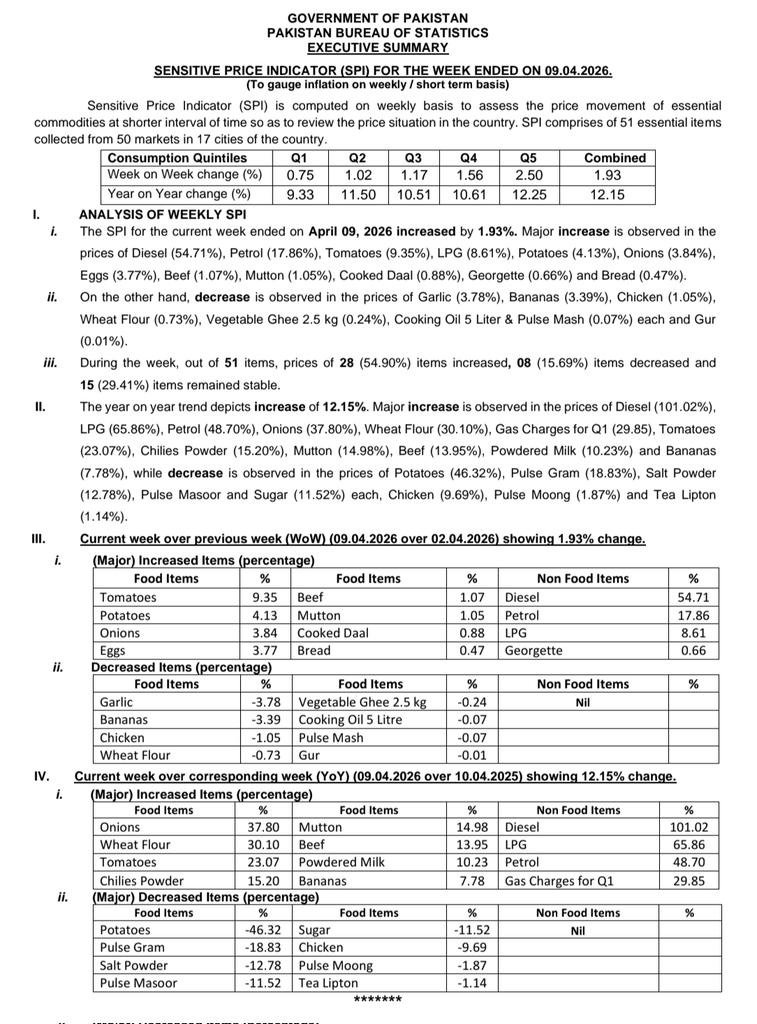
Some relief came from falling prices in garlic (down 3.78%), bananas (3.39%), chicken (1.05%), and wheat flour (0.73%). Vegetable ghee, cooking oil, pulse mash, and gur also recorded marginal declines, though analysts caution that these dips are too modest to offset the broader upward trend.
Out of the 51 tracked items, 28 (54.90%) recorded price increases during the week, 8 (15.69%) declined, and 15 (29.41%) remained stable.
The year-on-year picture is equally sobering. The SPI rose 12.15% compared to the same week last year. Diesel leads all annual gainers at 101.02%, followed by LPG at 65.86% and petrol at 48.70%. Onions surged 37.80% year-on-year, wheat flour 30.10%, tomatoes 23.07%, and chilies powder 15.20%. Mutton and beef also recorded double-digit annual increases of 14.98% and 13.95% respectively.
Not all annual trends moved upward. Potatoes fell 46.32% year-on-year, offering some relief to consumers. Pulse gram dropped 18.83%, salt powder 12.78%, pulse masoor and sugar 11.52% each, and chicken 9.69%. These declines, while notable, remain overshadowed by the scale of increases in fuel and core food categories.
For ordinary Pakistanis, the data translates into tangible daily hardship. A family relying on LPG for cooking, commuting via public transport, and buying vegetables at local markets is now facing simultaneous cost increases on nearly every front. Policy observers argue that sustained fuel price volatility, combined with persistent food inflation, demands a coordinated government response targeting both supply-side disruptions and energy pricing structures.
With 12.15% year-on-year inflation and fuel costs more than doubling, Pakistan’s cost-of-living crisis shows no sign of cooling down.
The PBS releases SPI data weekly as an early-warning gauge of inflationary trends, allowing policymakers to respond before pressures harden into broader CPI movements. Whether this week’s sharp reading translates into sustained inflation or reflects short-term supply shocks remains to be seen, but the data will likely intensify calls for relief measures ahead of the budget season.